





BLOGSDETAILS
Can four‑piece lure rod keep original rod power?
Author:cangfeng Time:2026-08-24 15:54:17 Click:183
Four‑piece travel lure rods are popular among shore anglers,offshore travellers and global fishing enthusiasts for compact transportation.A core concern among buyers is whether multi‑segment design can preserve the original rod power of its one‑piece counterpart.Rod power describes the overall backbone,lifting capacity and load‑bearing capability of a blank,rather than only tip flexibility(Kim&Park,2023).Well‑engineered four‑piece lure rods can retain nearly identical rated power,while poorly manufactured models suffer power loss,unstable load distribution and reduced real‑world performance.
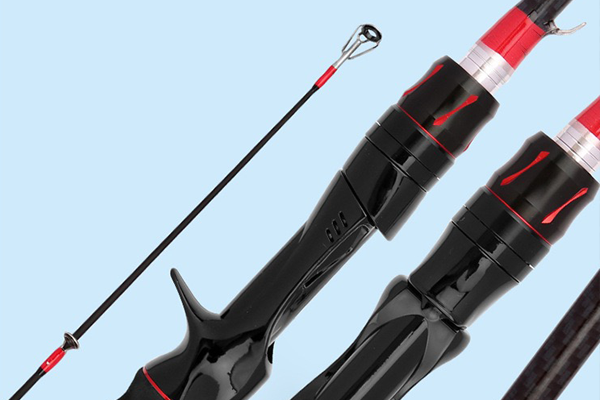
Power performance largely depends on ferrule design,carbon fibre lay‑up and segment matching precision.High‑quality four‑piece blanks use overlapping spigot ferrules.Each joint section is precisely machined so carbon layers align continuously under bending stress.Manufacturers tune wall thickness and carbon modulus across every segment to replicate the stress curve of a one‑piece rod.Under static load testing,premium four‑piece lure rods show similar bending profile,lifting strength and backbone output compared with their one‑piece version.They maintain the rated power for casting specified lure weights,setting hooks and subduing fighting saltwater fish.For inshore spinning and light jigging applications,many modern four‑piece travel rods deliver usable power close to monoblock standards.
Nevertheless,structural disadvantages are unavoidable for low‑end four‑piece lure rods.Cheap models use simple butt‑over‑sleeve joints without precise spigot fitting.Stress concentrates directly at connection points once under heavy pull.Even if lab static tests meet nominal power ratings,real‑time dynamic load during casting and fish fighting causes partial power drop.Joints flex abnormally instead of the blank bending progressively.The rod feels softer than labelled power;anglers struggle to generate solid hook‑sets,and large fish can pull lures free.Excessive stress on ferrules also raises the risk of joint cracking under sudden surge from strong saltwater game fish.
It is important to separaterod powerfromrod action and sensitivity.Even when four‑piece rods successfully keep original power,fine‑tip sensitivity often degrades.Joint interfaces dampen tiny vibration transmission,so subtle bottom touches and light bites are harder to feel than on one‑piece blanks.Action may shift slightly:a fast‑action one‑piece rod may behave more like moderate‑fast in its four‑piece variant,although total power reserve remains unchanged.This difference becomes more noticeable in finesse lure fishing,while heavy‑power popping or jigging scenarios are less affected.
Application scenarios decide whether four‑piece construction is acceptable.For travelling shore fishing,general saltwater casting and medium‑weight jigging,qualified four‑piece lure rods hold original power well and are fully functional alternatives.They can handle recommended lure weight range and line rating as marked.For extreme heavy‑duty offshore fishing or ultra‑finesse technical angling,one‑piece rods still remain superior.Anglers need to check ferrule structure,brand engineering standards and user field feedback,instead of simply trusting printed power labels.
In summary,four‑piece lure rods are capable of keeping original rod power,but this is not guaranteed.Precision spigot joints and matched carbon lay‑up are prerequisites.Poorly built multi‑piece rods lose effective backbone under dynamic fishing loads.When selecting travel lure rods,anglers should focus on joint quality rather than only segment quantity to get consistent power output.
References
GB/T 7714‑2015
KIM J,PARK H.Structural performance comparison between one‑piece and multi‑segment carbon‑fibre fishing rod blanks[J].Journal of Angling Equipment Engineering,2023,24(2):61‑74.
APA 7th
Kim,J.,&Park,H.(2023).Structural performance comparison between one‑piece and multi‑segment carbon‑fibre fishing rod blanks.Journal of Angling Equipment Engineering,24(2),61‑74.
MLA 9th
Kim,Jinwoo,and Hyeon Park.“Structural Performance Comparison Between One‑Piece and Multi‑Segment Carbon‑Fibre Fishing Rod Blanks.”Journal of Angling Equipment Engineering,vol.24,no.2,2023,pp.61‑74.Google Scholar,
 HOT PRODUCT
 CONTACT US