





BLOGSDETAILS
How does carbon fiber telescopic extension pole perform?
Author:cangfeng Time:2026-08-24 11:02:36 Click:83
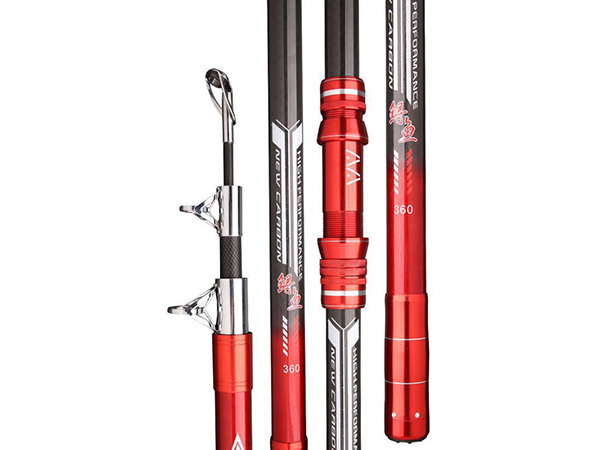
Carbon fiber telescopic extension poles deliver distinct overall performance driven by composite blank characteristics,joint precision and manufacturing quality,widely adopted as fishing‑oriented collapsible poles for both freshwater and saltwater angling.Compared with traditional fiberglass and metal telescopic poles,carbon‑fiber‑built products stand out in strength‑to‑weight ratio,corrosion resistance and signal transmission,yet their practical output is heavily affected by wall thickness,fiber layup and nested‑section workmanship.Not all carbon telescopic poles offer equal performance;low‑grade mixed‑carbon versions cannot match high‑density pure‑carbon models,creating obvious gaps in stiffness,anti‑wear property and long‑term reliability for field fishing scenarios.
Lightweight performance constitutes one of its most prominent advantages.Carbon fiber composite material achieves much lower density than glass fiber or aluminum alloy.Under equal strength requirements,carbon‑made telescopic extension poles reduce total weight significantly.For anglers who hike along streams,walk across rocky coasts or spend hours holding rods,lower weight relieves wrist and arm fatigue substantially during all‑day fishing activities.Even long fully‑extended models keep balanced weight distribution and avoid severe top‑heavy conditions.This lightweight feature does not come at the cost of bending resistance.High‑quality carbon blanks maintain sufficient backbone rigidity,storing elastic energy during casting to support relatively long casting distance while delivering fast response when setting hooks against target fish.
Sensitivity and environmental adaptability further improve field usability.Carbon fiber transfers vibration efficiently,so subtle bite signals from small fish can pass along the blank to angler’s hands,helping users identify faint strikes under flowing river current or turbulent surf conditions.As an inorganic composite material,carbon fiber itself will not rust when exposed to salt spray,humid air or splashing seawater.Unlike metal poles that suffer chemical corrosion,the main risk lies in matching metal accessories such as guide rings and reel seats.If supporting hardware applies anti‑corrosion treatment,the whole pole adapts well to coastal saltwater and damp freshwater reservoir environments.Proper surface coating further defends against ultraviolet aging during long‑time outdoor sunlight exposure.
Nevertheless,carbon fiber telescopic extension poles have non‑negligible performance limitations.Carbon composite material shows excellent tensile performance yet remains vulnerable against sharp‑point impact and side collision.Hard knocks against rocks,piers or hard ground may produce invisible micro‑cracks on blank surfaces.These tiny defects will expand under repeated bending stress and eventually trigger sudden fracture.The nested telescopic joints represent another performance bottleneck.Even premium carbon poles will develop joint wobble after long‑term friction with sand and silt.Poorly‑processed joints bring loose locking,power loss and abnormal rattling when fighting fish.Excessively thin‑walled carbon blanks pursue ultra‑light weight but sacrifice anti‑impact capability,raising break risk under overload.
Actual performance also relies heavily on reasonable operation and routine maintenance.Anglers should avoid overloading beyond marked load range,refrain from striking hard surfaces,and clear sand and silt from joint surfaces before retracting segments.Rinse thoroughly with fresh water after saltwater fishing and achieve full drying before storage.High‑modulus pure‑carbon telescopic extension poles deliver outstanding comprehensive performance for frequent outdoor angling.Carbon‑fiberglass mixed composite poles cut down costs for casual intermittent use,while inferior low‑carbon blended products show poor stiffness and fast wear,which should be distinguished during purchasing.
To sum up,qualified carbon fiber telescopic extension poles provide lightweight build,high stiffness,good bite sensitivity and natural salt‑corrosion resistance,bringing satisfying performance for shore,rock,stream and reservoir fishing.Still,they are susceptible to sharp impact damage and joint abrasion.Real‑world performance depends on raw‑material grade,component matching and daily maintenance rather than the“carbon fiber”label alone.Anglers should select specifications matching fishing scenarios and operate within rated load limits to obtain stable long‑term service.
References
1.GB/T 7714‑2015 Format
[1]MANSSOR A S,YUSOFF M Z.Bending Deflection and Mechanical Performance of Carbon‑Fiber Telescopic Composite Poles[C]//IOP Conference Series:Materials Science and Engineering.IOP Publishing,2020.[2026‑08‑24].
2.APA‑7th Format
Manssor,A.S.,&Yusoff,M.Z.(2020).Bending deflection and mechanical performance of carbon‑fiber telescopic composite poles.IOP Conference Series:Materials Science and Engineering.
3.MLA‑9th Format
Manssor,Aini Sabrin,and Mohd Zuki Yusoff.“Bending Deflection and Mechanical Performance of Carbon‑Fiber Telescopic Composite Poles.”IOP Conference Series:Materials Science and Engineering,vol.834,no.1,2020,
 HOT PRODUCT
 CONTACT US